The funnel friction playbook
A practical operating manual for diagnosing decision friction in B2B funnels.
The funnel friction playbook
A practical operating manual for diagnosing decision friction in B2B funnels.
Why this exists
I’ve watched too many B2B teams do the same thing when growth stalls. They add spend. They add tools. They add channels.
Very few stop to ask whether buyers are actually able to move forward.
Most funnels don’t fail because of traffic or channels. They fail because decision cost accumulates quietly. Small delays, unclear handoffs, and mismatched intent compound until progress stalls.
This playbook exists to help you find those hidden breakpoints and remove them, before you add more traffic, tooling, or budget.
This is not something you read once. You run it.
What this playbook helps you do
- Identify where buyers lose momentum across the funnel
- Diagnose friction before increasing spend or complexity
- Decide what to fix next with confidence
This playbook is for teams with traffic and demand, but inconsistent conversion. It is not for early experimentation, and it is not for teams looking for shortcuts.
The operating model
A B2B funnel is not a journey. It is a sequence of decisions made under uncertainty.
The behavioural flow you are diagnosing looks like this:
Arrive → Explore relevance → Look for proof → Decide to engage → Evaluate risk → Get internal approval
Friction appears when one of these decisions becomes harder than the buyer expects.
Every decision in this playbook follows one rule.
Optimise for downstream clarity, not upstream volume.
Your job is not persuasion. It’s to reduce decision cost.
Before you start
This playbook assumes three things.
First, you are tracking meaningful events in GA4. At a minimum: lead submission, demo booked, trial started, and key commercial page views such as pricing and case studies. Use your own event names. Keep the intent consistent.
Second, you know which pages are meant to move buyers forward. Product pages, solution pages, pricing, proof, and onboarding. This is not about optimising blog consumption.
Third, you accept an important constraint upfront.
GA4 is excellent at diagnosing pre-conversion behaviour. It is weak once conversations move into email, meetings, procurement, and contracts. Stage three requires triangulation with your CRM. If you ignore this, your conclusions will be wrong.
Stage one. Awareness friction
Where relevance is unclear, and the session ends in seconds.
What breaks Relevance mismatch.
What to look for High entry volume, low engagement.
What success looks like The buyer reads, scrolls, and stays.
At this stage, the buyer is not evaluating your product. They are deciding whether it is relevant enough to justify attention. If relevance is unclear, the session ends quickly.
I call this false momentum. Impressions and clicks increase, but progress does not.
What usually causes it
- A mismatch between the promise that drove the visit and the first screen the buyer sees
- Language that describes the company instead of the problem
- History instead of the buyer’s headache
What removes it
Immediate clarity.
The buyer must quickly understand:
- Who this is for
- What problem it removes
- What low-risk step comes next
How to diagnose awareness friction in GA4
Open Reports → Engagement (or Generate leads) → Landing page, then sort by sessions. These are your front doors.
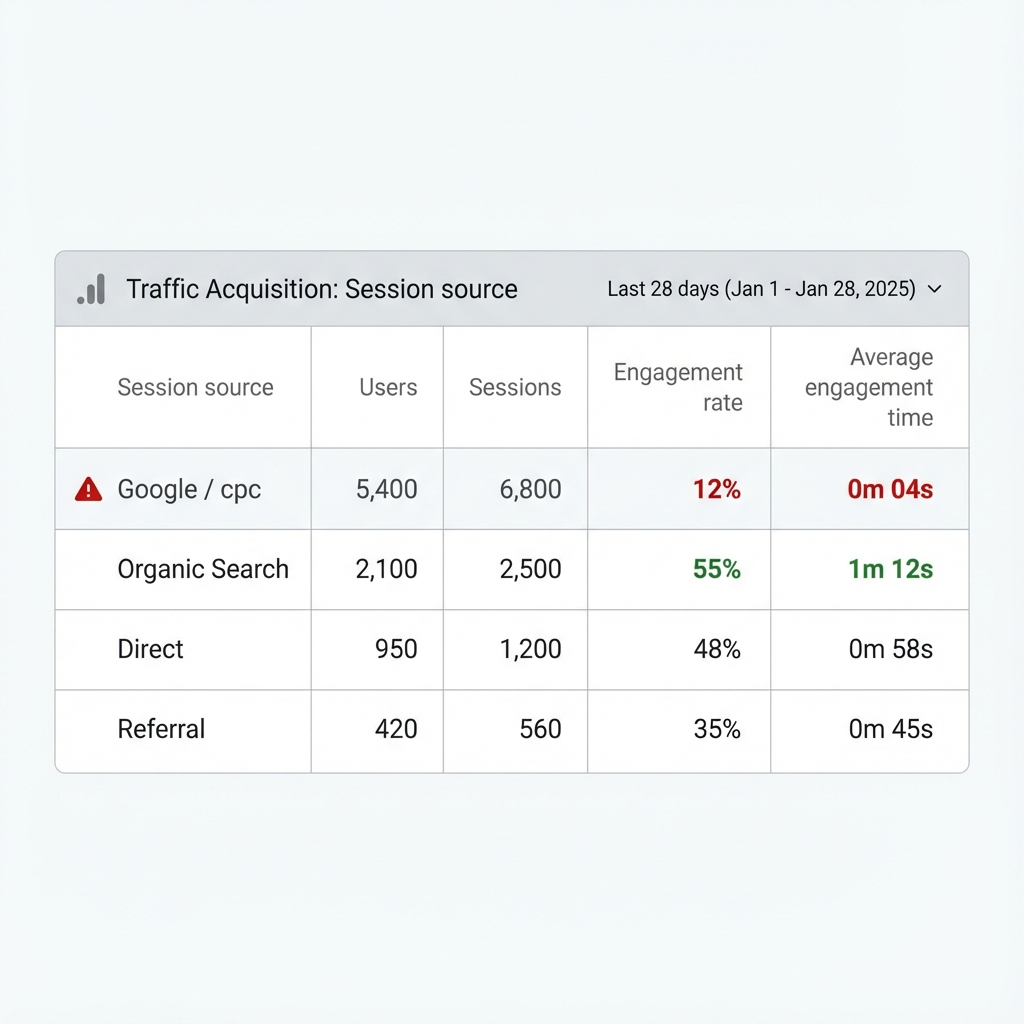
Look for commercial pages with strong traffic and weak engagement. Product pages, solution pages, and campaign landing pages. Not blog posts.
High volume with near-zero engagement means the promise that drove the visit does not match the reality of the page.
Next, open Reports → Acquisition (or Generate leads) → Traffic acquisition, and add Landing page as a secondary dimension.
If paid traffic disengages while organic performs better, the promise and the page are misaligned.
If all traffic disengages, the page itself is unclear.
This is not a demand problem. It is a relevance problem.
What fixing awareness friction actually looks like
You do not fix awareness friction with more content.
You fix it by making the first visible section of the page do real work. It must answer the three questions above without effort.
When this clarity exists, engagement improves without increasing traffic volume. When it does not, no downstream optimisation compensates.
If you can’t explain why a lead converted, your funnel is optimising noise.
Stage two. Consideration friction
Where intent exists, but confidence collapses.
What breaks Risk evaluation.
What to look for Looping behaviour, repeated pricing views.
What success looks like Linear progression toward intent.
Here, the buyer is engaged but not committed.
This is not a shopping phase. It is a risk-reduction phase. Buyers are asking whether it is safe and worthwhile to proceed.
What usually causes it
- Missing context
- Proof that is too generic
- Calls to action that demand commitment too early
- Gated assets that increase perceived risk at the wrong moment
What removes it
Decision support.
Clear proof, relevant examples, and next steps that feel like progress, not obligation.
How to diagnose consideration friction in GA4
Go to Explore → Funnel exploration and build a simple behavioural funnel:
- Entry point, such as session_start
- Product or solution page view
- Proof, such as pricing or a case study
- Primary conversion event
You are not looking for a perfect funnel. You are looking for sharp drop-offs.
A large drop between product engagement and conversion signals hesitation, not rejection.
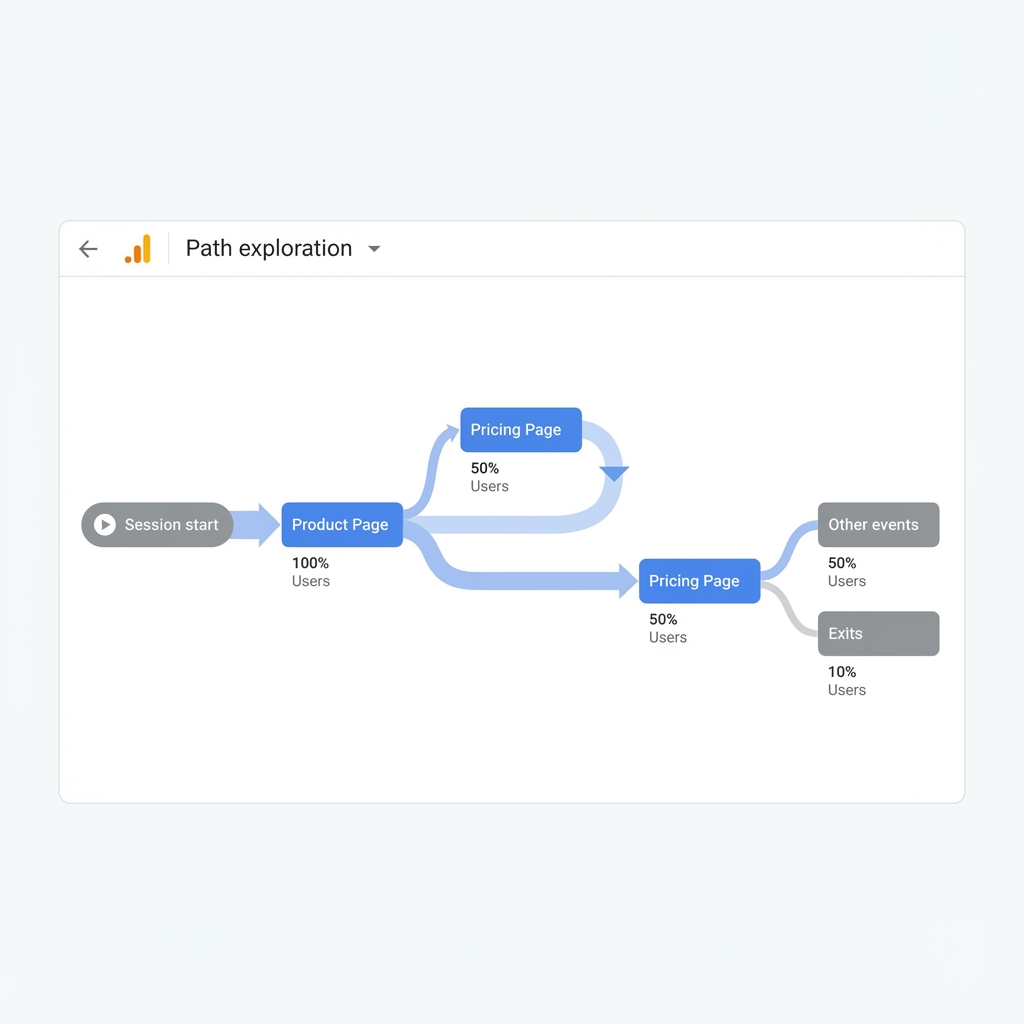
Next, use Explore → Path exploration, starting from a conversion event and working backwards.
- Pages that consistently appear before conversion support the decision
- Pages that repeatedly precede exits create friction
Looping behaviour, such as Product → Pricing → Product, signals an unanswered question.
A common source of friction. Mistimed gating
One of the most common consideration blockers in B2B funnels is asking for an email too early.
If buyers are still trying to reduce risk and proof is gated, you increase decision cost at exactly the wrong time.
Gating is not inherently wrong. Mistimed gating is.
If the buyer asks “Can I trust this?” and the site responds “Give me your email first”, momentum stalls.
What fixing consideration friction actually looks like
You do not fix consideration friction by pushing harder calls to action.
You fix it by guiding the decision the buyer is already trying to make. Show how the product applies to companies like theirs, what success looks like in practice, and what the next step represents in effort and risk.
When the path is clear, intent forms naturally.
If you can’t explain why people hesitate here, optimisation elsewhere won’t save you.
Stage three. Decision friction
Where the buyer wants it, but cannot defend the purchase internally.
What breaks Internal justification.
What to look for Stalled deals, ghosting after demos.
What success looks like Predictable close velocity.
This is the most expensive friction in the funnel.
This is the deal everyone agrees on in the demo, then quietly dies in procurement.
What usually causes it
- Justification friction
- Onboarding anxiety
- Internal politics
- Process and contract overhead
What removes it
Support for the buyer’s internal sale.
Clear pricing logic, predictable onboarding, and materials that reduce internal effort.
How to locate decision friction properly
In GA4, monitor late-stage intent signals such as pricing views, demo bookings, security or compliance pages, and implementation content.
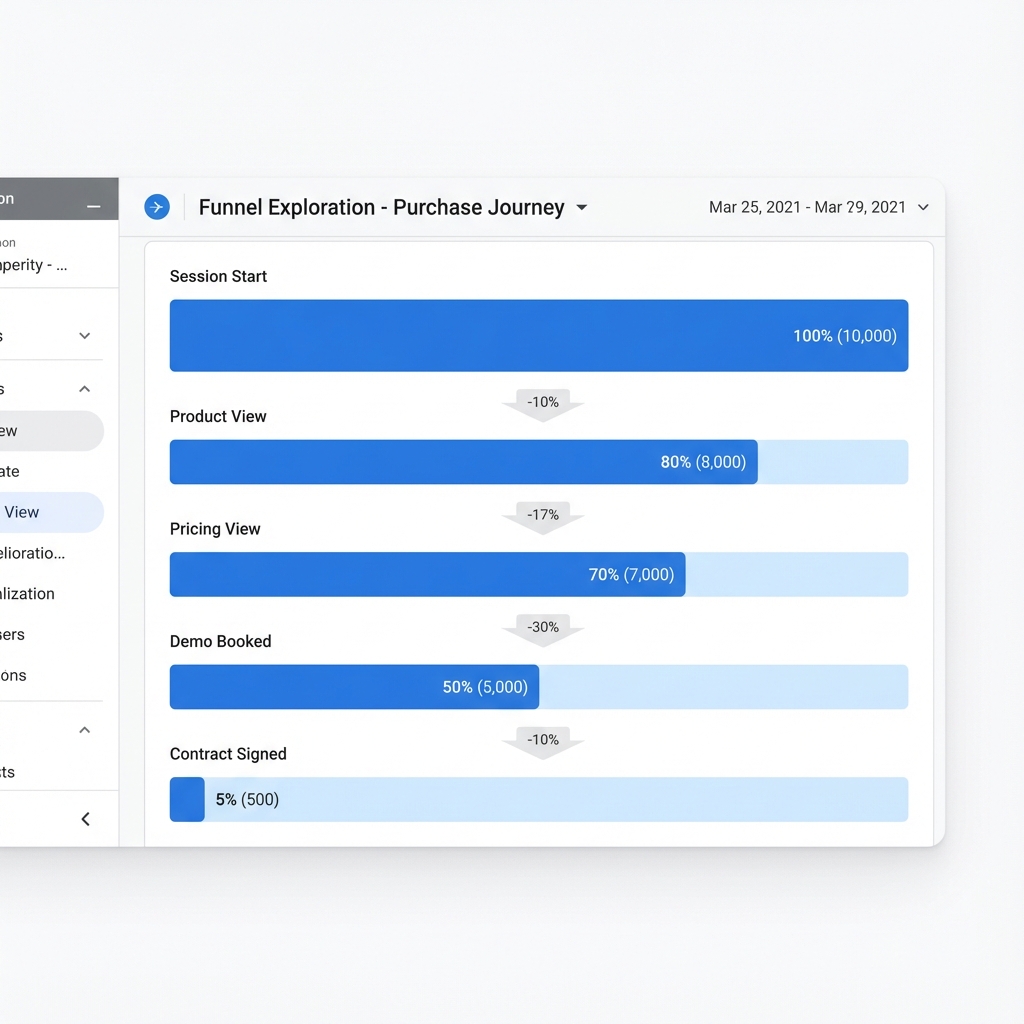
A sharp drop after “Demo booked” is not a sales failure. It is a failure of internal defence.
Then move to your CRM.
Compare the timestamp of demo booked with the timestamp of deal closed. If this gap consistently exceeds your typical sales cycle by a meaningful margin, you are not facing a sales execution issue. You are facing decision friction.
Look for repetition. The same objection. The same delay. The same silence point. Repetition reveals friction.
What fixing decision friction actually looks like
Most B2B deals do not fail because of competitors. They fail because internal momentum dies.
The fix is not pressure. The fix is support.
In practice, this often means creating a Champion’s one-pager. A short, internal-ready document the buyer can forward to finance or leadership. It explains:
- The job the product does
- The outcome it delivers
- How the cost is justified
- What onboarding looks like
When buyers can defend the purchase internally, deals close faster.
The goal is momentum, not pressure.
How to use this playbook
This is not theoretical.
- Scan the stages and mark friction points
- Pick one stage and ignore the rest
- Fix handoffs before optimising volume
Closing
If this playbook surfaced uncomfortable truths, that’s a good sign.
Friction compounds quietly. Clarity compounds faster.
This is how I think about funnels. This is how I diagnose growth problems. And this is the work I help teams do when traffic is not the real issue.
Funnel friction audit checklist
Copy-paste friendly.
Awareness
-
I verified GA4 events exist for lead submission, demo booked, and trial started.
-
I reviewed high-traffic commercial landing pages
-
I identified pages with strong sessions but low engagement
-
I validated whether disengagement is concentrated in paid traffic, indicating promise-to-page mismatch
Consideration
- I built a funnel exploration using entry point, product page, proof page, and conversion
- I identified the largest drop-off
- I reviewed path exploration to detect looping behaviour
- I checked whether gating increases risk at the proof stage
Decision
- I tracked late-stage intent signals in GA4 and compared demo timestamps with CRM close timestamps
- I flagged deals exceeding the typical sales cycle by more than twenty per cent
- I identified the repeating objection and created one Champion’s one-pager to reduce approval friction